

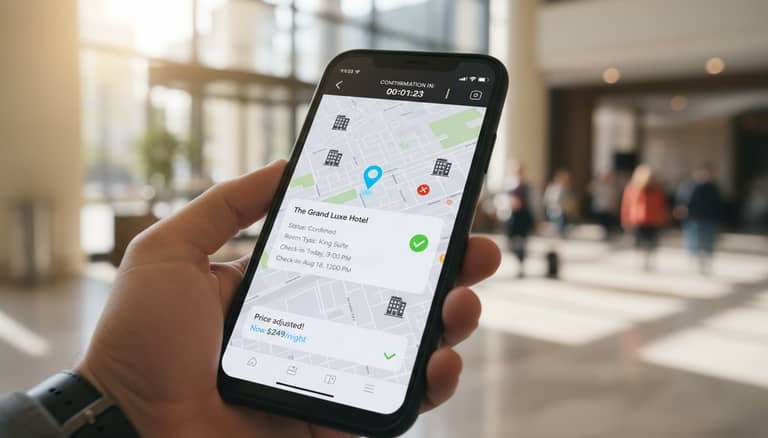
Hotel Booking with Real-Time Updates Is Broken (and How to Win)
Written with AI assistance under our editorial guidelines
Hotel booking confirmations often appear instant but mask outdated backend systems and fragmented databases that struggle to sync inventory in real time. This lag between customer confirmation and actual hotel records creates overbooking disasters and phantom rooms, leaving travelers arriving to find no reservation despite receiving confirmation, exposing how industry promises of instant availability frequently fail to deliver.
Picture this: you’re standing outside a neon-lit hotel lobby at midnight, phone in hand, your app proudly flashing “Confirmed”—yet the front desk attendant just shook their head. No room, no record, and no clue what went wrong. Welcome to the raw underbelly of hotel booking with real-time updates—a digital revolution that promises instant gratification but often delivers chaos behind the scenes. As travel platforms wage war for your attention, “real-time” has become a buzzword, yet the truth is tangled in legacy tech, fragmented data, and the persistent specter of overbooking. In 2024, nearly half of all hotel bookings are now direct, mobile traffic dominates search, and artificial intelligence claims to analyze your every preference. But does the promise of instant hotel availability, live deals, and AI-driven accommodation matching hold up under scrutiny? Or are we buying into an illusion that leaves travelers stranded, hoteliers overwhelmed, and the very idea of trust in digital travel dangling by a thread? This deep-dive exposes seven unapologetic truths every traveler needs to know about real-time hotel booking—demystifying the tech, revealing industry secrets, and arming you with the knowledge to sidestep booking disasters for good.
Why real-time matters: the hidden chaos of hotel booking
The illusion of instant confirmation
There’s a seductive certainty in tapping “Book Now” and watching your phone spit out an instant confirmation. Most travelers, fried from endless scrolling, trust that digital ping as gospel. But here’s the rub: not all confirmations are created equal. The supposed real-time hotel availability is too often a mirage—a byproduct of outdated backend systems, slow-moving channel managers, and a labyrinth of disconnected databases. The average traveler believes their booking is ironclad because of a digital timestamp or cheery green checkmark, yet the reality is messier and, at times, brutal.

The lag between your click and the hotel’s actual inventory update can be the difference between “welcome” and “we’re full.” According to Jamie, a veteran hotel manager:
“Most guests assume real-time means ‘right now.’ The truth is messier.” Such gap-riddled systems breed double bookings, phantom rooms, and a growing sense that instant confirmation is less a promise than a gamble.
Backstage technology: from travel agents to AI
Hotel booking technology has evolved from the smoke-filled offices of travel agents scrawling on paper ledgers to today’s AI-infused platforms promising instant results. Early online travel agencies (OTAs) brought speed, but their tech relied on batch updates—meaning what you saw wasn’t always what you got. Now, platforms like futurestays.ai leverage real-time data pipes, machine learning, and dynamic pricing to match travelers with available rooms in seconds.
| Era | How It Worked | Pros | Cons |
|---|---|---|---|
| Human Travel Agents | Phone calls, physical records | Personalized, local knowledge | Slow, error-prone, limited reach |
| Early OTAs (2000s) | Batch database updates, static sites | 24/7 access, broad inventory | Data lag, overbooking risk, impersonal |
| Modern AI Platforms | Real-time APIs, AI matching | Speed, accuracy, personalization | Tech-dependent, still limited by hotel systems |
Table 1: The evolution of hotel booking technology from human agents to AI-driven platforms
Source: Original analysis based on Phocuswright, 2023, Hospitality Upgrade, 2024
By 2024, direct bookings are projected to account for half of all hotel reservations, with platforms like futurestays.ai accelerating the shift toward real-time matching and transparency, according to HFTP, 2024.
When real-time goes wrong: case studies in booking disasters
The horror stories aren’t urban legends—they’re the ugly truth hiding in plain sight. Picture a traveler landing in Tokyo after a 14-hour flight, only to be told their “confirmed” hotel room was given away hours earlier. Or a family reunion unraveling at check-in due to inventory lag. The villains? Data latency, inconsistent updates between OTAs and hotel systems, and the dreaded overbooking.

Here’s the anatomy of a booking disaster: an OTA lists a room as available, but the hotel’s system updates inventory only every 15 minutes. Another guest books that same room via a different platform seconds before your payment clears. The result? Two “confirmed” bookings for one bed. These glitches are more common than most travelers realize—especially during peak seasons or major events.
Red flags to watch out for when booking hotels online:
- Absence of visible update timestamps next to availability or pricing
- Lack of instant confirmation (email or push notification delay longer than 60 seconds)
- No real-time inventory indicator (e.g., “Only 2 rooms left—just updated”)
- Poor customer support or unclear cancellation policies
- Frequent site outages or unexplained payment errors
The tech behind the promise: how real-time hotel booking actually works
APIs, channel managers, and data latency explained
At the core of genuine real-time hotel booking lies a digital choreography involving APIs (Application Programming Interfaces), channel managers, and a constant battle with latency. Think of an API as a translator—connecting your booking app to the hotel’s inventory database and ensuring the numbers align.
Key terms and their real-world impact:
The digital bridge transmitting real-time hotel availability, price, and confirmation data directly between platforms and hotel systems. A well-built API minimizes delays and syncs data every few seconds.
Software used by hotels to update room availability across multiple OTAs and platforms simultaneously. Channel managers are critical, but if misconfigured or slow, they become a bottleneck for instant hotel confirmation.
The delay between an action (like booking a room) and the system’s recognition of that action. Even milliseconds can cause overbooking during high demand events.
Platforms like Booking.com or Expedia that aggregate inventory from thousands of hotels. OTAs rely on system-wide updates, which can be delayed or incomplete.
When any part of this chain falters, the entire promise of live hotel deals and real-time updates collapses—leaving travelers exposed to old-school errors cloaked in new-school tech.
AI-powered platforms: separating hype from reality
AI is the new darling of travel tech. Platforms such as futurestays.ai tout their ability to crunch vast datasets—user preferences, weather, local events, and even historical price trends—to deliver hyper-personalized, instant hotel matches. According to HospitalityNet, 2024, AI-driven dynamic pricing can increase hotel revenue by up to 15%, while real-time machine learning, as used by the Lavender Heights hotel, achieved a similar growth in direct bookings.

Yet, there’s an uncomfortable truth: AI can only work as fast as the slowest system in the chain. As Alex, a seasoned travel tech lead, notes:
"AI speeds up everything—unless the hotel’s own system drags it down." The best AI accommodation finder is still at the mercy of legacy property management systems and patchy internet connections.
Cross-industry lessons: what hotels can learn from airlines and rideshares
Airlines have mastered real-time seat availability and dynamic pricing for decades, with booking systems that update instantly based on demand, cancellations, and even weather disruptions. Rideshare apps like Uber or Lyft update driver availability and pricing in real time, reacting to hyperlocal demand surges (“surge pricing”).
| Feature | Hotels | Airlines | Rideshares |
|---|---|---|---|
| Real-time inventory updates | Variable (often lag) | Near-instant | Instant |
| Dynamic pricing | Increasingly common | Standard practice | Standard practice |
| Overbooking risk | High (peak periods) | Managed with rules | Low |
| Cross-platform sync speed | Often delayed | High-speed | Instant |
Table 2: How real-time booking systems in hotels stack up against airlines and rideshares
Source: Original analysis based on Phocuswright, 2023, Navan Travel Insights, 2024
Hotels are catching up, but fragmented tech makes true real-time updates rare. Lessons for the hotel sector? Invest in consistent API integration, demand true inventory sync from partners, and borrow the airline industry’s playbook for instant customer communications.
The dark side: when real-time booking fails travelers
Horror stories and hidden costs
Consider the business traveler arriving late after a weather delay, clutching a confirmation code, only to find their hotel locked and lights off. The double booking, the “phantom” room, the helpless tech support loop—it’s not just inconvenient, it’s expensive. Real-time failures can trigger costly last-minute rebookings, credit card holds, and “convenience” fees that wipe out any perceived deal.

Beyond the emotional toll, hidden costs proliferate. Credit cards are often pre-authorized for amounts far beyond the listed price. And if a system glitch triggers a price surge, travelers may be forced to pay double at check-in.
Hidden benefits of hotel booking with real-time updates experts won’t tell you:
- Price drop alerts that let you snag last-minute deals below published rates
- Greater cancellation flexibility as inventory is updated instantly
- Exclusive, app-only promotions not available on slower platforms
- Immediate notification of changes—so you can act before disaster strikes
- Access to rooms released from cancellations in real time
Overbooking, price jumps, and data glitches
Despite the promise of precision, overbooking remains rampant—especially during high-demand events or in regions with fragmented tech infrastructure. According to SiteMinder, 2024, average booking lead time increased to 32 days, but cancellations dropped below 20%. Even so, when systems lag, a room can be sold twice before the dust settles.
Price jumps are another landmine. Real-time updates, when interrupted by system hiccups, can trigger sudden, unexplained spikes—a phenomenon travelers experience as “bait-and-switch” but which often stems from unsynchronized data rather than malice.
| Region | Overbooking Rate (%) | Price Jump Incidents | Data Glitch Frequency |
|---|---|---|---|
| North America | 2.5 | 15/month | Moderate |
| Europe | 3.1 | 19/month | Moderate-High |
| Asia-Pacific | 3.8 | 25/month | High |
Table 3: Estimated overbooking and price jump incidents by region based on 2024 data
Source: Original analysis based on SiteMinder, 2024, Navan, 2024
Debunking myths: not all 'real-time' is created equal
Marketers love to slap “real-time” on anything that pings in under a minute. But as Priya, a leading OTA analyst, puts it:
"If it doesn’t show the update timestamp, it’s not real-time—period." Travelers should be skeptical of platforms that hide update timing, use vague confirmation language, or lack live inventory indicators. True real-time hotel booking platforms display when inventory was last synced and offer immediate confirmation—anything less is just smoke and mirrors.
Real-world impact: who wins and who loses with real-time hotel booking
Travelers: peace of mind or information overload?
On the surface, real-time updates offer travelers a sense of control—instant inventory, price tracking, and confirmation. But there’s an edge to this digital empowerment. Research from Navan, 2024 reveals that while mobile accounts for over 70% of travel traffic, the flood of notifications can overwhelm, not reassure.
Too many alerts, last-second availability changes, and fluctuating prices can spike stress, especially for less tech-savvy or risk-averse travelers.

The upshot? Real-time can be a blessing for those who crave control, but a curse for those who prefer set-and-forget simplicity.
Hoteliers: new challenges and opportunities
For hotels, the real-time revolution is a double-edged sword. On one hand, it promises higher occupancy and optimized pricing; on the other, it demands constant vigilance, staff retraining, and—ironically—the risk of ceding control to algorithms and aggregators.
Step-by-step guide to mastering real-time updates as a hotelier:
- Evaluate and select a robust, modern channel manager with proven real-time sync capabilities.
- Integrate all booking platforms via standardized APIs to minimize latency.
- Train staff to monitor system health and inventory across platforms in real time.
- Establish escalation protocols for data discrepancies or system glitches.
- Regularly audit booking and cancellation logs for anomalies.
- Collaborate with AI-driven platforms like futurestays.ai to broaden reach while maintaining inventory integrity.
- Solicit feedback from guests about the booking process to uncover pain points.
The rise of AI accommodation finders like futurestays.ai
The new wave of AI accommodation finders is rewriting the rules. These platforms offer more than speed—they promise radical transparency, instant inventory, and personalized matches based on granular traveler data. The shift is seismic: according to HFTP, 2024, direct AI-powered bookings are on track to match traditional OTAs in volume, slashing costs and increasing flexibility for both travelers and hoteliers.
Platforms like futurestays.ai are at the forefront of this transformation, embedding AI not just in search but in dynamic pricing, review analysis, and post-stay feedback. This isn’t just an incremental upgrade; it’s a fundamental reimagining of how hotel booking with real-time updates delivers value across the travel ecosystem.
Global differences: why real-time isn’t universal
Cultural and regional adoption gaps
Despite the global branding of major booking platforms, the rollout of genuine real-time updates is uneven. Regions vary widely in digital infrastructure, regulatory stance, and consumer expectations. In parts of Asia-Pacific and Africa, for example, hotels may still update inventory manually or via batch uploads, creating a lag that no amount of AI can erase.

Market fragmentation, currency volatility, and payment system incompatibility further slow adoption. Meanwhile, strict data privacy rules in Europe and North America force platforms to adjust inventory and communication protocols, reducing the risk of “phantom” confirmations but limiting real-time flexibility.
Localization: language, payment, and data challenges
One size never fits all in global travel tech. Translation errors, payment barriers, and localized data privacy regulations present massive hurdles to seamless, real-time hotel booking. For example, a platform may display perfect real-time availability, but if a traveler’s credit card isn’t accepted or a vital email confirmation gets lost in translation, the booking is at risk.
Global platforms adapt by partnering with local payment providers, customizing notification preferences, and deploying region-specific support teams. Yet, the balancing act between speed, compliance, and user experience is ongoing.
Priority checklist for implementing real-time hotel booking in new markets:
- Secure partnerships with local payment processors and banks.
- Localize content—translate not just words but cultural references and notification styles.
- Comply with regional data privacy and consent requirements.
- Test real-time inventory sync using local hotel systems.
- Train customer support in region-specific booking issues.
- Monitor for fraud and technical glitches unique to each market.
Actionable strategies for travelers: how to avoid booking disasters
Identifying truly real-time platforms
Not all booking apps are built equal. The platforms most likely to deliver on the promise of true real-time hotel availability display clear update timestamps, send immediate confirmations, and offer human support for edge cases. Beware of sites that hide behind generic language (“confirmation within 24 hours”) or bury inventory updates in footnotes.

Red flags to watch out for when booking hotels online:
- No visible timestamp on room availability or price
- Confirmation emails that take longer than a few minutes to arrive
- Vague promises of “confirmation soon” without details
- No live chat or phone support for urgent issues
- Multiple discrepancies between app and hotel website inventory
Timing your booking: when to act and when to wait
Booking timing is both art and science. According to SiteMinder, 2024, average lead time has grown to 32 days as travelers chase better deals and flexibility. The sweet spot? Book early for peak periods, but use real-time alerts for last-minute deals and cancellations during off-peak times.
| Year | Key Milestone | Booking Tech Evolution |
|---|---|---|
| 2000 | Early OTAs launch | Batch updates, manual sync |
| 2008 | First mobile hotel booking apps | Increased mobile access |
| 2015 | Channel managers gain popularity | Faster inventory sync |
| 2020 | AI-powered platforms emerge | Dynamic pricing, matching |
| 2024 | Real-time APIs widespread, mobile leads | Instant confirmation trend |
Table 4: Timeline of hotel booking with real-time updates evolution from 2000 to 2025
Source: Original analysis based on Event Temple, 2024, Navan, 2024
Leverage price trackers, set up cancellation alerts, and resist the urge to “panic book” during system slowdowns—these are your best defenses.
Pro tips for crisis-proof travel
The most seasoned travelers know that the best defense is a layered approach. Always double-check your booking with the hotel directly, especially for high-stakes trips. Save all notifications and confirmation numbers, and familiarize yourself with the platform’s escalation procedures.
Key concepts in crisis-proof travel:
A booking status delivered within seconds of payment, including a timestamp and reservation code from the hotel’s system.
Real-time price adjustments based on demand, inventory, and market signals, powered by AI or algorithmic engines.
A recommended window (usually 60-90 minutes) between booking and arrival, allowing systems to sync and resolve discrepancies.
Developing these habits can mean the difference between a seamless check-in and a night spent searching for a backup room.
The future of real-time hotel booking: what’s next?
AI, blockchain, and the next wave of disruption
While this article focuses on current realities and proven systems, cutting-edge travel tech continues to push boundaries. Experiments with blockchain confirmations, predictive AI for room demand, and biometric authentication are underway at select properties, but these remain the exception, not the rule in 2024.

Even now, data privacy concerns and algorithmic bias are real risks—travelers should demand transparency about how their data is used and how “matching” decisions are made.
How travelers and the industry can adapt
Adapting to the relentless pace of travel tech requires a mix of vigilance and flexibility.
Step-by-step guide to mastering hotel booking with real-time updates:
- Research platforms and look for evidence of true real-time syncing.
- Enable and customize notification settings to avoid information overload.
- Book with a “buffer”—don’t leave arrival and booking within the same hour.
- Confirm with the hotel, especially for high-demand periods or complex stays.
- Keep all digital and physical confirmation records handy at check-in.
- Provide immediate feedback on booking issues—platforms adapt fastest when users speak up.
- After your stay, review both the hotel and the booking experience to help others.
Final thought: redefining trust in the digital travel era
Trust in travel has shifted from handshakes across granite counters to swipes on glass screens. The technology is the new contract—one that demands transparency, accountability, and a relentless focus on the traveler, not just the sale. As Taylor, an industry consultant, puts it:
"Trust is becoming digital, not just personal. The tech is the handshake now." So whether you’re booking a last-minute hideaway or planning a global adventure, demand more from your platforms. Read the signs, question the promises, and choose the hotel booking with real-time updates that’s built on substance—not just speed.
FAQs and quick reference: your real-time hotel booking survival kit
Frequently asked questions
How do I know if my hotel booking is truly real-time?
Look for platforms that display update timestamps next to room availability and send immediate, detailed confirmations. Cross-check with the hotel directly if in doubt and avoid apps with vague or delayed confirmation language.
What should I do if my booking status changes after confirmation?
Contact both the booking platform and the hotel immediately. Save all notifications and request written proof of any changes. If stranded, escalate to platform support and document your experience for potential compensation.
Are real-time hotel booking apps safe to use?
Most leading platforms use secure payment gateways and robust data encryption. However, always check for visible update timestamps, confirm with the hotel, and use platforms with responsive customer support for added peace of mind.
Quick reference checklist for travelers
- Always verify room availability timestamps before booking.
- Save all booking confirmations and notifications—digital and printed.
- Confirm your reservation directly with the hotel, especially for critical trips.
- Use platforms that offer live customer support and transparent cancellation policies.
- Enable price drop and cancellation alerts to maximize flexibility and savings.
- Avoid booking via unfamiliar platforms without clear update protocols.
- Keep backup accommodation options in mind for high-demand periods.
- Provide feedback post-stay to help improve real-time booking for others.
Sources
References cited in this article
- SiteMinder Hotel Booking Trends(siteminder.com)
- Event Temple Hotel Statistics 2024(eventtemple.com)
- Navan Travel Booking Stats(navan.com)
- HospitalityNet Case Study(hospitalitynet.org)
- Phocuswright Real-Time Revolution(phocuswright.com)
- Hospitality Upgrade(hospitalityupgrade.com)
- Cloudbeds Tech Trends(cloudbeds.com)
- HFTP Tech Trends(hftp.org)
- Statista Digitalization(statista.com)
- UNDRR Disaster Case Studies(undrr.org)
- Munich Re Natural Disaster Figures(munichre.com)
- Hospitality Technology(hospitalitytech.com)
- Booking.com AI Features(news.booking.com)
- Statista AI Use in Hospitality(statista.com)
- ScienceDirect AI Review Summaries(sciencedirect.com)
- EHL Hospitality Insights(hospitalityinsights.ehl.edu)
- Skift Booking Data Gaps(skift.com)
- Agilysys Overbooking(agilysys.com)
- Lighthouse Price Trends(mylighthouse.com)
- Northwestern MLDS(sites.northwestern.edu)
- TravelBoom Myths(travelboommarketing.com)
- HospitalityNet(hospitalitynet.org)
- HFTP(hftp.org)
- TravelPerk Stats(travelperk.com)
- Statista AI Use(statista.com)
- OpenXcell AI in Travel(openxcell.com)
- NetSuite AI in Hospitality(netsuite.com)
- SoftwareAdvice Futurestay Review(softwareadvice.co.nz)
- D-EDGE Report(d-edge.com)
- HVS Global Recap(hvs.com)
- AccomNews Tech Gap(accomnews.com.au)
Find Your Perfect Stay, Instantly
Futurestays.ai transforms the way you find accommodations by leveraging cutting-edge AI technology to analyze extensive databases and deliver highly personalized hotel and apartment recommendations in seconds. Whether you're traveling for leisure, business, or adventure, our intuitive platform ensures you find the perfect stay tailored to your style, budget, and requirements. Say goodbye to endless scrolling and tedious filtering, and hello to quick, precise, and effortless accommodation booking.
Get startedReady to Find Your Perfect Stay?
Let AI match you with your ideal accommodation today
Frequently Asked Questions
What happens when a hotel booking shows as confirmed but the hotel has no record of it?
This occurs due to lag between the booking platform's confirmation and the hotel's actual inventory update, caused by outdated backend systems and disconnected databases. The digital confirmation may arrive before the hotel's system processes the reservation, leading to overbooking and guests being turned away despite receiving a confirmation.
Why can't hotel booking apps provide truly real-time availability?
Real-time hotel booking is hindered by legacy technology systems, slow-moving channel managers, and fragmented data across disconnected databases. These outdated backend systems create delays between when a booking is confirmed digitally and when it actually registers in the hotel's inventory.
What percentage of hotel bookings are direct, and how does this relate to the real-time booking problem?
In 2024, nearly half of all hotel bookings are now direct, with mobile traffic dominating search. This shift toward direct bookings and mobile-first platforms has intensified the real-time booking challenges as travel platforms compete for attention with imperfect technology.
Can you trust a digital confirmation timestamp or green checkmark when booking a hotel?
No—according to the article, the average traveler wrongly believes their booking is secure because of a digital timestamp or green checkmark, but this is a false sense of certainty. The reality is messier, as confirmations may not reflect the actual hotel inventory status.
Keep Reading
Keep exploring AI accommodation finder

Real Time Hotel Booking: Pitfalls and Proven Strategies

Hotel Booking with Availability Updates: Why Real-Time Claims Mislead

Real-Time Hotel Availability: How the System Really Works

Hotel Availability Is Lying to You (and How AI Exposes It)

How Hotel Online Booking Innovations Reshape Travel Decisions


