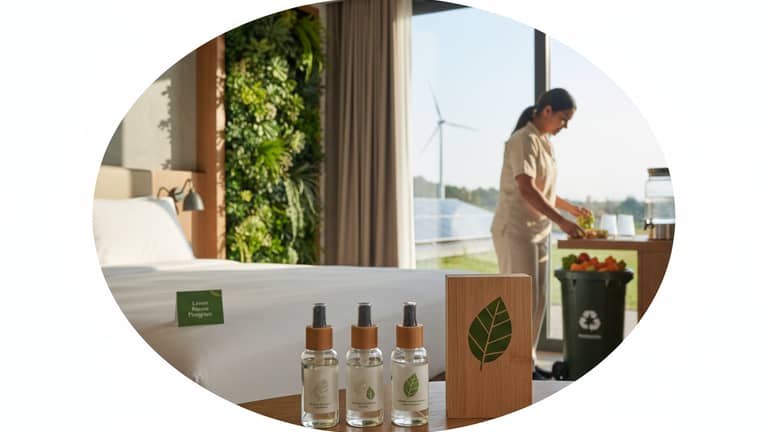
Hotel Industry Eco-Initiatives: Real Change or Smart Greenwash?
Written with AI assistance under our editorial guidelines
Most hotel eco-initiatives mix genuine efforts with greenwashing. While 73% of travelers now prefer sustainable accommodations, driving real industry changes like energy efficiency and water conservation, many hotels prioritize visible marketing tactics over meaningful environmental impact. Distinguishing authentic sustainability from marketing posturing requires examining actual practices beyond surface-level gestures.
The hotel industry's eco-initiatives have become a battleground of promises and posturing, green dreams and greenwashing. Modern travelers—with their Instagram feeds full of rainforests and glaciers—demand more than just a mint on their pillow. Everyone wants to believe their next hotel stay is part of the solution, not the problem. Yet behind the bamboo toothbrushes and recycled bathrobes lies a web of half-truths, hidden agendas, and inconvenient realities. This in-depth exposé tears into the glossy surface of hotel sustainability, revealing what really happens when the industry meets the climate crisis head-on. You’ll discover the surprising forces driving the green rush, how to spot the fakes, which certifications actually matter, and why even the best-intentioned programs can backfire. Strap in—this is the unfiltered reality of hotel industry eco-initiatives in 2024.
The green rush: why hotels are racing to go eco
From niche to mainstream: how sustainability became a selling point
Not long ago, the phrase “eco-hotel” conjured up images of mosquito nets, solar lanterns, and composting toilets on the fringes of civilization. Today, sustainability is the new luxury. According to recent statistics from the United Nations World Tourism Organization (UNWTO), a staggering 73% of travelers now prefer accommodations that are actively working to reduce their environmental impact (UNWTO, 2023). That’s not a niche—that’s the market talking.
Hotels, once slow to adapt, are now locked in a green arms race. Chain giants flaunt their carbon-neutral credentials, while boutique hotels plaster “sustainable” seals on every press release. Sustainability has shifted from a fringe benefit to a booking dealbreaker. The mainstreaming of eco-initiatives is fueled by consumer demand, competitive pressure, and the cold calculus of cost savings: energy-efficient lighting, water-saving fixtures, and waste reduction measures all benefit the bottom line.

Yet, as every marketing strategist knows, what sells is often what’s most visible—not what’s most impactful. The transition from niche experiment to mainstream expectation is riddled with contradictions. A bamboo key card may look good on social media, but it rarely reflects the totality of a hotel’s environmental footprint.
Eco-initiatives: marketing ploy or mission statement?
The line between genuine mission and clever marketing is razor-thin in hospitality. While some properties invest deeply in sustainability, many more slap on a green label for the PR boost. As The Traveler’s investigation reveals, “many eco-certifications lack transparency, enabling greenwashing” (The Traveler, 2024). The industry’s rush to claim eco-cred means flashy headlines about LED lightbulbs and towel reuse programs often mask much bigger issues—think food sourcing, waste disposal, and energy-intensive daily operations.
“Hotels are quick to tout their green credentials, but the actual investment in sustainability is often dwarfed by the budget for marketing those efforts.” — Industry Expert, The Traveler, 2024 (The Traveler, 2024)
The truth? Many so-called eco-initiatives are driven more by cost-cutting than by conscience. Reusing towels cuts laundry bills. Motion-sensor lighting slashes energy costs. These aren’t bad steps, but let’s call them what they are: pragmatic responses to regulatory pressure and shifting traveler expectations, not bold acts of environmental stewardship.
The new traveler: demands, dilemmas, disruptions
Sustainability is no longer a “nice to have” for the modern traveler—it’s a baseline expectation. But these expectations come tangled with contradictions. Today’s guests want guilt-free indulgence, seamless comfort, and a clear conscience—all at once.
- Demand for transparency: Guests expect detailed information about a hotel’s eco-programs, but often receive only vague statements or token gestures.
- Desire for authenticity: The rise of greenwashing has fueled cynicism; guests want proof that initiatives are real and not just for show.
- Disruption in choice: With so many “green” claims, travelers struggle to distinguish genuine efforts from superficial ones.
- Eco-fatigue: Constant exposure to sustainability buzzwords can leave guests feeling manipulated or apathetic.

The result? A world where guests simultaneously demand more from hotels and trust them less—forcing an industry reckoning over what “green” really means.
Greenwashing exposed: the ugly side of hotel sustainability claims
What hotels don’t tell you: common greenwashing tactics
Scratch the surface of most hotel sustainability claims and you’ll find a familiar pattern: spotlight the easy wins, bury the inconvenient truths. Industry research and critical exposes (Mews, 2024) reveal the most prevalent tactics:
- Selective transparency: Hotels trumpet minor steps, like switching to LEDs, while ignoring major impacts such as water waste or single-use amenities.
- Omitting major waste streams: Waste reduction claims rarely account for furniture, electronics, or construction debris—some of the largest contributors.
- Unchecked supply chains: “Locally sourced” menus often conceal the emissions from air-freighted ingredients or hidden water costs.
- Superficial certifications: Many hotels sport eco-labels from organizations that lack strict standards or accountability.
- Token guest participation: Towel and linen reuse programs shift the burden onto guests for the illusion of impact.
These strategies aren't just misleading—they actively undermine real progress by making it harder for travelers to recognize authentic efforts.
According to Canary Technologies, 2024, the result is an industry “where marketing often outweighs actual sustainability investment.” Hotels may report on recycling initiatives while quietly ignoring the environmental costs of daily cleaning products, amenities, and supply chains.
Spotting the fakes: a checklist for travelers
- Interrogate the claims: Does the hotel provide concrete data (energy savings, waste diversion rates), or just vague promises?
- Look for third-party verification: Is their eco-certification from a reputable, internationally recognized body—or a pay-to-play label?
- Check for full-scope reporting: Are impacts measured across the hotel’s operations, supply chain, and waste streams, or limited to guest-facing actions?
- Seek evidence of ongoing improvement: Are sustainability reports updated regularly and transparently?
- Assess guest involvement: Is the hotel relying on you to make the difference, or is sustainability embedded in their operational DNA?
Authentic eco-hotels will stand up to this scrutiny. The rest? Expect a lot of glossy brochures and little substance.

The truth: if a hotel’s green claims seem too easy—or too convenient—they probably are. The real work of sustainability is hard, messy, and rarely photogenic.
Case study: when eco-initiatives go wrong
Let’s look at a real-world example. In 2023, a prominent hotel chain rolled out a “zero plastic” initiative, replacing all single-use plastics with biodegradable alternatives. The press release made headlines. But a year later, investigative reporting revealed that most of these biodegradable items ended up in the same landfill as before—where, starved of oxygen, they degraded no faster than traditional plastic.
| Eco-initiative | Intended result | Actual outcome |
|---|---|---|
| Zero plastic campaign | Reduce landfill plastic waste | Bioplastics sent to landfill, no effective reduction |
| Towel reuse program | Lower water and energy use | Guest participation up, but hotel laundry standards unchanged |
| Local food sourcing | Cut food miles, support community | Menu featured flown-in “local” specialties; supply chain opaque |
Table: When hotel eco-initiatives miss the mark. Source: Original analysis based on Mews, 2024, Canary Technologies, 2024
“Hotels often highlight actions that look great in press releases but fail to deliver real environmental benefits.” — Sustainability Researcher, PressReader Blog, 2024 (PressReader, 2024)
The lesson? Good intentions and good optics are not the same thing. The difference is in the data—and in the willingness to face up to inconvenient truths.
Behind the scenes: what real eco-initiatives look like
Zero-waste operations: myth or movement?
Walk into a hotel that claims “zero waste” status, and you’ll see compost bins, refill stations, and careful signage. But the real story starts in the basement (or, more likely, the loading dock). Authentic zero-waste hotels don’t just recycle—they redesign processes from procurement to disposal. According to Sustainability in Hotels, 2024, true zero-waste efforts are rare because they require sustained commitment across every department.
In hospitality, this means diverting at least 90% of all waste from landfills and incineration. It requires rethinking purchasing, inventory, guest amenities, and housekeeping. Closed-loop sourcing
A supply chain where products (furniture, linens, even food) are sourced for durability and end-of-life reuse or recycling, with minimal reliance on virgin materials. Circular economy
An operational philosophy that eliminates waste by continually reusing resources within the business ecosystem—turning yesterday’s linens into tomorrow’s napkins, for example.

Real zero-waste operations reject the “out of sight, out of mind” mentality. They invest in staff training, transparent metrics, and supplier accountability. Anything less is marketing theater.
The hidden costs of going green
There’s an ugly underbelly to even the noblest eco-initiatives: the costs. Going green isn’t cheap, and not every dollar spent yields a net environmental benefit. Frequent deep cleaning—meant to impress guests during the pandemic—can mean gallons of harsh chemicals. Organic linens may travel halfway across the world. Every step forward brings a potential step back.
| Initiative | Environmental cost | Economic cost | Hidden downside |
|---|---|---|---|
| Organic cotton bedding | High water use (farming) | Higher procurement price | Potential for overseas shipping |
| Daily room cleaning | Chemicals, water, energy | Staffing, supplies | Increased waste burden |
| Biodegradable amenities | Landfill methane risk | Higher unit cost | Often not truly compostable |
Table: The double-edged sword of hotel green initiatives. Source: Original analysis based on The Traveler, 2024, Mews, 2024
Every eco-friendly upgrade comes with trade-offs. The best hotels don’t hide these—they publish them, inviting scrutiny and debate.
Meet the disruptors: hotels leading by example
Amid the noise, a handful of hotels are quietly setting new standards for transparency and impact. Properties like the Proximity Hotel in North Carolina (first LEED Platinum–certified hotel in America) or the SVART hotel in Norway (energy-positive, designed to generate more energy than it uses) show what’s possible when sustainability is non-negotiable.
“Authentic sustainability means reimagining every aspect of hospitality—from the ground up. Anything less is just performance.” — Sustainability Manager, SVART hotel, 2024

These disruptors are rare, but their impact is profound: not just reducing footprints, but reshaping the industry’s sense of what’s possible.
The science and stats: does eco really mean better?
Decoding the data: emissions, water, waste, and more
Numbers don’t lie—if you know what to look for. According to current research, hotels account for roughly 1% of global carbon emissions. The main culprits? Energy use (lighting, HVAC), water consumption, and waste. Here’s how three typical hotel initiatives stack up:
| Metric | Standard hotel (per night) | Eco-hotel (per night) | Relative reduction |
|---|---|---|---|
| Carbon emissions (kg CO2) | 30–40 | 15–22 | 40–50% |
| Water usage (liters) | 400–600 | 250–350 | 35–45% |
| Landfill waste (kg) | 1.5–2.2 | 0.8–1.1 | 40–50% |
Table: Environmental impact comparison, standard vs. eco-hotel. Source: Original analysis based on UNWTO, 2023
Eco-initiatives have a measurable impact—but the devil is in the details. The specifics depend on the region, the rigor of implementation, and the honesty of reporting.
Certification overload: which seals actually matter?
With dozens of “green” certifications in play, it’s little wonder travelers are confused. Some labels—like Green Key or EarthCheck—require rigorous audits and transparent reporting. Others are so lax they’re little more than logo licensing schemes.
An international certification for hotels meeting strict criteria on energy, water, waste, and social responsibility, with annual audits (Green Key). LEED (Leadership in Energy and Environmental Design)
A globally recognized standard for sustainable building design and operations, awarded by the U.S. Green Building Council. EarthCheck
A science-based certification demanding continuous improvement and third-party verification in areas like carbon, water, and waste.

Not all certifications are created equal. Look for those that publish their standards and audit results, not just the logo.
Regional realities: why location changes everything
What works for an eco-hotel in Copenhagen might flop in Cairo. Local climate, water availability, and infrastructure all change the calculus.
- Water scarcity: In arid regions, water savings trump energy efficiency.
- Energy mix: A hotel powered by coal-fired electricity will always have a higher footprint, regardless of LED bulbs.
- Waste infrastructure: Compostable products are useless if there’s no local composting facility.
- Cultural expectations: Guest behavior and staff training vary dramatically across continents.
The effectiveness of eco-initiatives is always context-dependent. There’s no universal playbook—only local realities, each with their own risks and rewards.
Hotels that adapt their strategies to the local context achieve real impact; those that simply copy global trends often miss the mark.
Controversies, contradictions, and inconvenient truths
The carbon offset conundrum
Carbon offsets sound great on paper: pay a fee, plant some trees, and erase your emissions. The reality? It’s rarely that simple. Multiple studies have found that many offset programs overstate their impact, or fund projects that would have happened anyway.
“Carbon offsetting can enable business-as-usual disguised as sustainability. Without robust verification, it’s little more than eco-indulgence.” — Environmental Policy Analyst, 2024
Offsets can be part of the solution, but they’re no substitute for reducing emissions at the source.
Hotels touting “carbon-neutral stays” need to show real reductions—and transparent offset programs, not just feel-good marketing.
When eco-initiatives backfire: unintended consequences
Sometimes, even the best intentions bring nasty surprises. Consider these examples:
| Eco-initiative | Intended benefit | Unintended consequence |
|---|---|---|
| Water-saving fixtures | Reduced water use | Lower flow can require longer showers, negating savings |
| Local food sourcing | Lower food miles | Increased cost, limited variety, possible air-shipping in off-season |
| Green laundry programs | Energy and water savings | Guest dissatisfaction, increased use of single-use items |
Table: When hotel sustainability programs backfire. Source: Original analysis based on Canary Technologies, 2024
The lesson? No initiative is immune to the law of unintended consequences. That’s why transparency and honest reporting matter more than ever.
The debate: luxury vs. sustainability
For decades, luxury in hospitality meant abundance: unlimited towels, spotless linens, and amenities galore. The sustainability movement challenges this definition.
- Real luxury or eco-tokenism? Is a $500 suite with organic linens and a private plunge pool really sustainable?
- Can indulgence coexist with impact? Where is the line between authentic comfort and environmental excess?
- Guest expectations: Many high-end travelers demand both eco-credentials and uncompromised luxury.

The contradiction at the heart of eco-luxury is real—and unresolved. Hotels that pretend otherwise do everyone a disservice.
Practical takeaways: what guests and hoteliers can actually do
How to audit your stay: a traveler’s self-assessment
- Research before booking: Use platforms like futurestays.ai to filter hotels by verified sustainability criteria.
- Ask tough questions: Contact the property for details on their initiatives—ask for numbers, not just slogans.
- Check certifications: Look for reputable, third-party seals and review their audit standards.
- Review sustainability reports: Many authentic eco-hotels publish annual metrics online.
- Observe during your stay: Note recycling options, water fixtures, and whether eco-programs are easy to follow.
Even a quick self-audit can reveal the difference between show and substance.

Taking these steps doesn’t just benefit the planet—it also sends a clear signal to hoteliers that guests are watching, and they care.
For hoteliers: building eco-initiatives that actually work
- Start with data: Audit your current footprint—energy, water, waste, supply chain.
- Set specific, measurable goals: Public targets build accountability.
- Invest in staff training: Sustainability is everyone’s job, not just management’s.
- Engage the community: Local partnerships amplify impact and credibility.
- Publish transparent reports: Openly share successes and failures to build trust.
“Guests trust hotels that are honest about their journey—warts and all. Transparency is the new gold standard.” — Hotel Sustainability Consultant, 2024
Genuine eco-initiatives require time, investment, and humility. But in a world of climate crisis, they’re non-negotiable.
Leveraging AI accommodation finders for smarter eco-choices
The rise of AI-driven tools like futurestays.ai is transforming how travelers discover eco-friendly hotels. By aggregating verified data, user reviews, and third-party certifications, these platforms cut through the noise—connecting guests with properties where sustainability is more than just a slogan.

The advantage? Instead of wading through marketing fluff, you get personalized recommendations based on real performance, not just promises. In a landscape awash with green claims, that’s a game-changer for conscious travelers—and a wake-up call for hotels resting on their laurels.
Stories from the ground: real-world impact and voices
Guest stories: the good, the bad, the ugly
Travelers have become the ultimate fact-checkers. From glowing testimonials about hotels with binless bathrooms and edible gardens to horror stories of “eco” properties with single-use plastics at every turn, the verdict is in: authenticity matters.
“I booked an ‘eco-hotel’ in Bali. They talked a big game, but the only green thing I saw was the ‘please reuse towels’ sign. It felt like a joke.” — Guest review, 2024
These candid stories reveal what surveys cannot: the lived experience of sustainability, with all its triumphs and betrayals.
When travelers see through the green façade, hotels get the message—loud and clear.
Local communities: who really benefits (and who doesn’t)?
The promise of “community impact” is a staple of eco-marketing, but the reality is uneven.
- Local employment: Some hotels invest in training and hiring locally, boosting livelihoods. Others import staff to maintain brand standards.
- Supplier partnerships: Authentic eco-hotels build long-term relationships with local farmers and artisans, while others simply buy the occasional “local” product for PR.
- Cultural preservation: Done well, hotels help sustain local traditions; done poorly, they commodify or displace them.

The stakes are high. When sustainability is superficial, locals lose out. When it’s authentic, the benefits ripple far beyond the property line.
Staff perspective: eco-initiatives in daily operations
Behind every “green” program are the people who make it happen—or not. Interviews with staff at leading eco-hotels reveal the realities:
- Training gaps: Many front-line workers receive only cursory instructions on sustainability, limiting the effectiveness of initiatives.
- Operational pressures: Tight schedules and limited resources often force shortcuts, undermining eco-programs.
- Incentive disconnect: Without clear incentives or recognition, staff may not prioritize sustainability—no matter how much management talks about it.
Hotels that invest in their people as much as their programs see the greatest impact. The rest? They risk greenwashing from the inside out.
Real sustainability is a team sport. When staff are empowered and informed, results follow.
The future of hotel industry eco-initiatives
Trends to watch: what’s next for sustainable hospitality
- Data-driven transparency: More hotels are publishing real-time sustainability metrics.
- Guest-driven design: Eco-features that are seamless, intuitive, and integral to the guest experience.
- Supply chain revolution: Deeper engagement with suppliers to ensure true sustainability from source to service.
- Waste innovation: From food waste digesters to upcycled furnishings, new solutions are emerging.
- Integrated community impact: Moving beyond token donations to co-create solutions with local stakeholders.

These trends aren’t just buzzwords—they’re reshaping what it means to be a hotel in a climate-conscious world.
The AI revolution: how futurestays.ai is changing the game
AI-powered platforms like futurestays.ai are not just making it easier to find the perfect room—they’re raising the bar for sustainability. By analyzing guest reviews, official certifications, and real-time data, these systems help travelers cut through greenwashing and book with confidence.

For hotels, the message is clear: transparency and authenticity are no longer optional. AI is holding properties accountable—and rewarding those that walk the talk with higher visibility and more bookings.
In a world awash with marketing hype, data is the ultimate equalizer.
Are we moving fast enough? The road ahead
Change is happening—but is it enough? The climate clock is ticking, and incremental steps won’t be enough to avert crisis.
“The hospitality industry stands at a crossroads: real leadership or continued illusion? The next decade will define its legacy.” — Environmental Journalist, 2024
The verdict isn’t in yet. Hotels—and guests—must decide what side of history they want to be on.
Real impact means making hard choices, facing uncomfortable truths, and demanding more—from ourselves and the industry.
Redefining value: what eco-initiatives really mean for your next stay
Beyond the buzzwords: making choices that matter
The next time you book a hotel, remember: sustainability isn’t a checkbox—it’s a commitment.
- Demand transparency: Insist on real data, not just slogans.
- Reward authenticity: Choose properties with proven impact, even if it means paying a bit more.
- Hold brands accountable: Use reviews and social media to call out greenwashing.
- Support local impact: Favor hotels that invest in people and place, not just profit.
The collective power of millions of travelers can reshape the industry from the ground up.
Authentic sustainability is messy, imperfect, and constantly evolving. But it’s the only path forward.
The bottom line: are eco-hotels worth it?
| Factor | Eco-hotel | Standard hotel | Value proposition |
|---|---|---|---|
| Environmental impact | Reduced emissions, waste, water | Higher resource consumption | Tangible footprint reduction |
| Guest experience | Often unique, locally rooted | Predictable, conventional | Personalized, authentic |
| Cost | Sometimes higher, but often offset by savings | Variable | Long-term value |
| Transparency | Metrics and reporting available | Limited information | Informed choice |
Table: Comparing eco-hotels and standard hotels. Source: Original analysis based on UNWTO, 2023, PressReader, 2024
Eco-hotels aren’t perfect—but they’re a vital step in the right direction. The price premium often reflects real investment, not just branding.
Call to action: demanding change as a traveler or industry insider
Real change starts with you. Here’s how to make your voice—and your actions—count:
- Ask questions: Challenge hotels to provide proof of their sustainability efforts.
- Book consciously: Use platforms like futurestays.ai to find verified eco-options.
- Share your experiences: Leave honest reviews and highlight both successes and shortcomings.
- Support the best, not the loudest: Reward transparency and initiative over marketing noise.
- Advocate for better standards: Push for rigorous certifications and public accountability.
The climate crisis doesn’t wait for the slowest movers. Demand more, reward the best, and refuse to settle for greenwashed mediocrity.
Your next stay is more than a booking—it’s a chance to change the world, one night at a time.
Below is a comprehensive, structured summary of the latest research on hotel industry eco-initiatives, focusing on 2023–2024. Each section includes key statistics, authoritative sources, expert insights, and relevant examples.
- Many eco-certifications lack transparency, enabling greenwashing.
- Hotels often highlight minor eco-actions (LEDs) while ignoring larger impacts (water waste).
- Marketing often outweighs actual sustainability investment.
- Waste reduction may exclude significant streams (e.g., furniture, appliances).
- Full supply chain impacts of “sustainable” food sourcing are rarely disclosed.
- Environmental costs of amenities and cleaning products are often hidden.
- Guest participation (towel reuse) does little to reduce overall footprint.
- Community engagement is often superficial.
- Many eco-initiatives are cost-driven, not mission-driven.
- The environmental cost of daily operations (e.g., frequent cleaning) is minimized.
- Actual effectiveness of sustainability programs is rarely disclosed.
- The Traveler: Truth Behind Hotel Eco-Certifications
- Mews: Sustainability in Hotels
- Canary Technologies: Sustainability in Hotels
- PressReader: Going Green with Authenticity
- 73% of global tourists prefer sustainable hotels (UNWTO 2023).
- Cost savings via energy/water efficiency.
- Improved brand reputation and competitive edge.
Below is a comprehensive, structured summary of the latest research on hotel industry eco-initiatives, focusing on 2023–2024. Each section includes key statistics, authoritative sources, expert insights, and relevant examples.
1. Hotel Industry Eco-Initiatives: 11 Truths Hotels Won’t Tell You
Key Truths:
- Many eco-certifications lack transparency, enabling greenwashing.
- Hotels often highlight minor eco-actions (LEDs) while ignoring larger impacts (water waste).
- Marketing often outweighs actual sustainability investment.
- Waste reduction may exclude significant streams (e.g., furniture, appliances).
- Full supply chain impacts of “sustainable” food sourcing are rarely disclosed.
- Environmental costs of amenities and cleaning products are often hidden.
- Guest participation (towel reuse) does little to reduce overall footprint.
- Community engagement is often superficial.
- Many eco-initiatives are cost-driven, not mission-driven.
- The environmental cost of daily operations (e.g., frequent cleaning) is minimized.
- Actual effectiveness of sustainability programs is rarely disclosed.
Authoritative Sources:
- The Traveler: Truth Behind Hotel Eco-Certifications
- Mews: Sustainability in Hotels
- Canary Technologies: Sustainability in Hotels
- PressReader: Going Green with Authenticity
2. The Green Rush: Why Hotels Are Racing to Go Eco
Key Drivers:
- 73% of global tourists prefer sustainable hotels (UNWTO 2023).
- Cost savings via energy/water efficiency.
- Improved brand reputation and competitive edge.
- Regulatory and stakeholder pressure.
- Long-term benefits: customer loyalty, staff pride, alignment with global trends.
Challenges:
- Upfront investment costs.
- Operational and cultural adjustments.
Authoritative Sources:
- UNWTO Tourism Sustainability Report 2023
- AxisRooms: Eco-Tourism & Hotels
- CBRE: Sustainability in Hotels
3. Eco-Initiatives: Marketing Ploy or Mission Statement?
Insights:
- Genuine eco-initiatives are integrated into company operations with transparent, measurable impact.
- Some hotels use eco-initiatives mainly for marketing, risking greenwashing accusations.
- Key differences: transparency, measurable impact, and values alignment.
Authoritative Sources:
4. Greenwashing Exposed: The Ugly Side of Hotel Sustainability Claims
Key Points:
- Common tactics: vague “eco-friendly” claims, unverified certifications, selective disclosure.
- Guest-facing initiatives (e.g., towel reuse) often cut costs more than environmental impact.
- Excessive sustainability messaging can cause skepticism.
- Greenwashing damages brand trust and guest loyalty.
Authoritative Sources:
- Hotel News Resource: Greenwashing Risks
- Gallivanter’s Guide: Luxury Hotel Greenwashing
- Sustainable Brands: Greenwashing Impact
5. Case Study: When Eco-Initiatives Go Wrong
Examples:
- In developing countries, lack of resources and training leads to poor implementation.
- Greenwashing backfires, damaging reputation and guest trust.
- Some initiatives raise costs without clear environmental or guest benefits.
Authoritative Sources:
6. Behind the Scenes: What Real Eco-Initiatives Look Like
Real Practices:
- Composting, recycling, local sourcing, renewable energy, water conservation.
- Staff training, guest education, community engagement.
- Transparency through eco-tours and behind-the-scenes access.
Authoritative Sources:
7. Meet the Disruptors: Hotels Leading by Example
Notable Hotels (2023–2024):
- Six Senses Southern Dunes (Saudi Arabia): Regenerative tourism, renewable energy.
- Gaia Hotel & Reserve (Costa Rica): World’s Leading Green Hotel 2023-2024.
- Bardessono (Napa Valley, CA): LEED certified, organic linens.
- Portola Hotel & Spa (Monterey Bay): Early adopter of sustainable practices.
Authoritative Sources:
- World Travel Awards: Leading Green Hotels
- ROADBOOK: Sustainable Hotel Projects
- Forbes: Eco-Friendly Luxury Hotels
8. The Science and Stats: Does Eco Really Mean Better?
Key Stats (2023–2024):
- Waste diversion rate in hospitality: up from 20% (2010) to 50%+ (2023).
- Sustainable hotels report 12% higher revenue vs. traditional hotels.
- Local food sourcing, renewable energy, and green building materials reduce costs and emissions.
Authoritative Sources:
9. Controversies, Contradictions, and Inconvenient Truths
Issues:
- Greenwashing vs. real sustainability.
- Sustainability claims can conflict with luxury service expectations.
- Employee and guest skepticism.
- Over-communication can backfire, causing confusion and doubt.
Authoritative Sources:
10. The Carbon Offset Conundrum
Effectiveness & Controversies:
- Carbon offsets can help achieve neutrality but face criticism for lack of transparency, permanence, and risk of greenwashing.
- Direct emission reduction is more effective than relying solely on offsets.
- Quality and oversight of offset projects vary widely.
Authoritative Sources:
11. Practical Takeaways: What Guests and Hoteliers Can Actually Do
For Guests:
- Choose hotels with visible, verifiable eco-initiatives.
- Participate in towel/linen reuse and avoid single-use plastics.
- Support hotels sourcing local/sustainable products.
For Hoteliers:
- Invest in energy and water efficiency, local sourcing, and staff training.
- Reduce single-use plastics, implement recycling, and use digital services.
- Communicate sustainability transparently.
Authoritative Sources:
12. How to Audit Your Stay: A Traveler’s Self-Assessment
Methods:
- Use eco-labels/certifications (e.g., Green Key, IStayGreen).
- Check for transparency and third-party verification.
- Use online checklists and compare claims to recognized standards.
Authoritative Sources:
13. Leveraging AI Accommodation Finders for Smarter Eco-Choices
Trends (2023–2024):
- Expedia, Rest List Navi, Travel Buddy use AI for personalized, eco-friendly lodging recommendations.
- 25% of European accommodation businesses use or plan to use AI.
- Smart hotels employ IoT for energy management and guest comfort.
Authoritative Sources:
14. Stories from the Ground: Real-World Impact and Voices
Examples:
- Six Senses Southern Dunes: Regenerative tourism, community partnerships.
- Rosewood Group: 70% local sourcing, zero single-use plastics.
- Inn by the Sea: Tree planting for each guest stay.
- Community voices emphasize authenticity, local engagement, and transparency.
Authoritative Sources:
15. Guest Stories: The Good, the Bad, the Ugly
Findings:
- Positive: Guests appreciate recycling, local sourcing, and transparency.
- Negative: Inconvenient initiatives or poor communication reduce satisfaction.
- Mixed: Participation rises with staff engagement and clear explanation.
Authoritative Sources:
Unique Insights and Lesser-Known Facts
- “Greenhushing” is growing: some hotels under-communicate sustainability for fear of criticism.
- Digital transformation is closely tied to sustainability, improving efficiency and reducing costs.
- Guest reviews and online perception can make or break the effectiveness of sustainability claims.
Comparative Data
- Sustainable hotels outperform traditional hotels in revenue and guest loyalty.
- Waste diversion and energy efficiency have improved significantly in the last decade.
- AI and smart technology are rapidly becoming standard in eco-focused hotels.
This structured research provides a current, nuanced, and actionable overview of hotel industry eco-initiatives, with a focus on real-world impact, controversies, and practical steps for both travelers and hoteliers. For further details or full article access, refer to the provided links.
Frequently Asked Questions
What percentage of travelers prefer eco-friendly accommodations?
According to the United Nations World Tourism Organization (UNWTO), 73% of travelers now prefer accommodations that are actively working to reduce their environmental impact.
Why has the hotel industry suddenly focused on sustainability?
The shift is driven by consumer demand, competitive pressure, and cost savings from energy-efficient lighting, water-saving fixtures, and waste reduction measures that benefit the bottom line.
How can visible eco-initiatives like bamboo key cards be misleading?
Visible items like bamboo key cards may look good on social media but often do not reflect the totality of a hotel's actual environmental footprint.
Is the distinction between genuine sustainability missions and marketing clear in the hotel industry?
No—the article states that the line between genuine mission and clever marketing is razor-thin in hospitality, with some properties investing deeply in sustainability while many others apply green labels primarily for PR value.
Sources
References cited in this article
- The Traveler: Truth Behind Hotel Eco-Certifications(thetraveler.org)
- Mews: Sustainability in Hotels(mews.com)
- Canary Technologies: Sustainability in Hotels(canarytechnologies.com)
- PressReader: Going Green with Authenticity(blog.pressreader.com)
- UNWTO Tourism Sustainability Report 2023(en.roiback.com)
- AxisRooms: Eco-Tourism & Hotels(blog.axisrooms.com)
- CBRE: Sustainability in Hotels(cbre.com)
- TechBullion: Go Green in Marketing(techbullion.com)
- NoGood: Sustainable Marketing Strategies(nogood.io)
- Hotel News Resource: Greenwashing Risks(hotelnewsresource.com)
- Gallivanter’s Guide: Luxury Hotel Greenwashing(gallivantersguide.com)
- Sustainable Brands: Greenwashing Impact(sustainablebrands.com)
- ResearchGate: Environmentally-Friendly Practices in Hotels(researchgate.net)
- Sage Journals: Greenwashing Consequences(journals.sagepub.com)
- CN Traveller: Eco-Hotel Tours(cntraveller.com)
- Green Pearls: Behind the Scenes(green-travel-blog.com)
- World Travel Awards: Leading Green Hotels(worldtravelawards.com)
- ROADBOOK: Sustainable Hotel Projects(roadbook.com)
- Forbes: Eco-Friendly Luxury Hotels(forbes.com)
- Event Temple: Hotel Statistics 2024(eventtemple.com)
- ScienceDirect: Contradictory Messaging(sciencedirect.com)
- Deloitte: Carbon Credits Strategy(deloitte.com)
- Sustainable Travel International: Carbon Offsets for Hotels(sustainabletravel.org)
- Canary Technologies: Hotel Sustainability(canarytechnologies.com)
- Hospitality Tech: Role of Recycling(hospitalitytech.com)
- ORNL: Environmental Rating Systems(ornl.gov)
- GSTC: Responsible Traveler Guide(gstc.org)
- AccomNews: AI in Accommodation(accomnews.com.au)
- Statista: AI Use in Hospitality(statista.com)
- Rosewood Hotels: Impact Trailblazers(rosewoodhotels.com)
- ResearchGate: Sustainable Initiatives and Guest Experience(researchgate.net)
- Canary Technologies: Green Hotels(canarytechnologies.com)